What a business bridge loan actually does #
A bridge loan pays a bill now and gets repaid later from money you already expect. Think of it as a short plank across a gap. You can see the other side, whether that is permanent funding or a payment that's coming, but you can't reach it yet.
The loan is not meant to fix a business that loses money every month. It is meant to fill a window: a deal closes in 60 days, a bank loan is approved but not yet funded, or a customer's invoice is due after payroll. When the permanent money lands, the bridge is paid off, usually in full.
Bridge loans are sized to the gap, not the whole business. Lenders look at the incoming payment first, so the amount tends to be smaller and the term shorter than a conventional loan.
Common situations where a bridge loan makes sense #
- A long-term loan is approved but not yet funded. The bank or SBA loan is coming, but closing takes weeks, and a supplier needs cash on delivery now.
- A contract pays on a slow schedule. You must buy materials and staff the job today, and the customer pays in 60 days or more.
- A property or equipment sale is closing. The sale proceeds will repay the bridge, and the closing date is on paper.
- A seasonal dip has a known recovery. Payroll and rent continue while sales are soft, but your records show when revenue returns.
- An insurance payment is pending. Claims can take time. A bridge can cover repairs and reopening costs until the check clears.
The test is the same in every case. Can you name the money that repays the loan, and when it arrives? If the answer is a date and a document, a bridge can work. If the answer is "hopefully business picks up," it can't.
How much a bridge loan costs, in plain numbers #
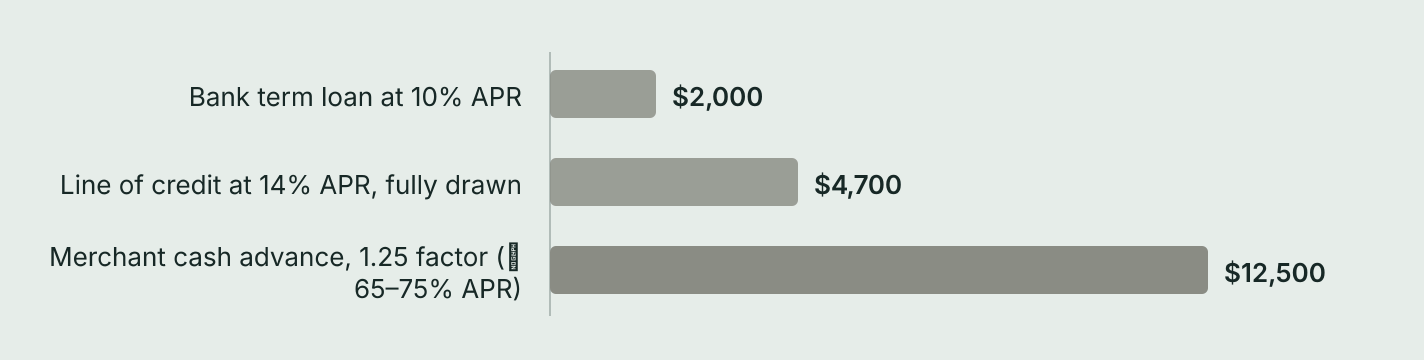
Short-term lenders often quote a factor rate, which is a multiplier on the amount you receive. For example, a 1.25 factor means you repay 1.25 times what you received. On $50,000, that is $62,500, or $12,500 in cost, no matter how quickly you pay it back. Repaid over eight months, that 1.25 factor is roughly 65–75% APR.
A factor rate is not an interest rate, and it can look smaller than it is. Because the full cost is charged over a short term, the annual-rate equivalent runs high. A 1.15 factor over six months is closer to 45–55% APR. The exact figure depends on how often payments are taken. Always compare the APR-equivalent against a bank quote.
The table sets the main options side by side for the same $50,000. The figures are illustrative.
| Option | Typical cost | Speed | What it needs |
|---|---|---|---|
| Bank term loan | For example, about $2,000 in interest over 8 months at 10% APR | Often weeks to months | Documented history, financial statements, often collateral and a personal guarantee |
| SBA 7(a) loan | Set by the lender within program rules; usually lower cost than short-term products | Usually the slowest; months is common | An eligible business, lender underwriting and SBA paperwork |
| Business line of credit | For example, about $4,700 in interest if the full $50,000 stays drawn for 8 months at 14% APR | Quick once open; opening takes time | Revenue history and an approved credit limit |
| Bridge loan (short-term) | For example, 1.15 factor over 6 months ≈ 45–55% APR, about $7,500 total cost | Often days to a few weeks | A clear repayment source and recent bank statements |
| Merchant cash advance | For example, 1.25 factor over 8 months ≈ 65–75% APR, about $12,500 total cost | Often days | Card sales or deposit history; repaid from a share of sales |
| Revenue-based financing | Fee or factor set per deal; compare the APR-equivalent | Often days to weeks | Consistent revenue, often with accounting or payment software connected |
Bridge loan versus bank term loan, SBA 7(a), and line of credit #
These are categories, and each has a job. Choose by timing and purpose, not by the name on the offer.
A bank term loan usually costs far less than a bridge loan. It suits a planned purchase or expansion when you have time and strong financials. The trade-off is speed. Many owners start at the bank by default and lose weeks they don't have, so if your gap has a deadline, ask for the funding date before you invest time in the application.
An SBA 7(a) loan is made by a bank or other participating lender with a partial SBA guarantee. The guarantee lets lenders offer longer terms, but the lender still does full underwriting and the paperwork takes time. It is a strong choice for a working-capital need that is not urgent. It is a poor choice for a payment due next week.
A business line of credit is flexible. You draw what you need, pay it down, and pay interest only on the amount drawn. It fits recurring gaps, such as seasonal inventory. If you don't already have one open, though, approval takes time you may not have.
A bridge loan wins on speed and on matching a single, dated repayment event. It loses on cost, because the short term makes the APR-equivalent high. Use it when the gap is real and short, and the payoff is certain.
For a broader view of how small firms apply for financing and how outcomes differ by lender type, see the Federal Reserve's Small Business Credit Survey. Results vary by lender, so don't assume your application will go the same way everywhere.
What lenders look at before approving a bridge loan #
Most short-term lenders ask for the same core items:
- Time in business and recent revenue. Several months of bank statements show your deposit pattern.
- Existing debt payments. Lenders check whether your current obligations leave room for another payment.
- The payoff source, on paper. This can be a signed contract, a closing statement, a commitment letter, or an invoice with a payment date. It matters more than anything else on a bridge request.
- Personal credit. Usually checked, and usually one input among several.
Lenders weigh cash flow and the repayment source heavily. A thin credit file with a signed sale in hand is often a stronger request than a high credit score with no clear exit.
When a bank or SBA loan is the better choice #
Choose a bank or SBA loan when the need isn't urgent, you can wait weeks for the money, and keeping the cost low matters most. It also fits when you are buying a long-lived asset, such as real estate or equipment, and want to spread payments over years. If your financials are clean and documented and you have a bank relationship, start there. You may get a lower rate than any short-term product can offer.
A bridge loan is the wrong choice when you need the money to cover ongoing losses, when repayment depends on sales you haven't made yet, or when the payment would strain your cash flow beyond the gap it is meant to cover.
Can I get a bridge loan with bad credit? #
Possibly, though the cost usually reflects the risk. Bridge lenders often look first at deposits and the repayment source, and a pending contract or sale can carry more weight than a low score. Expect a higher price, a shorter term and closer scrutiny of the payoff. Before you accept, compare the APR-equivalent against the cost of waiting, and confirm the payment fits your monthly cash flow.
How fast can a business get a bridge loan? #
Often within days once the application is complete. Speed depends on what you send: recent bank statements, basic business details and the paper that proves repayment, such as a signed contract or closing statement. Missing documents are the usual cause of delay. A bank loan on the same gap typically takes longer because of underwriting and closing steps. Ask for the funding date in writing before you sign, and plan the bridge around it.
What is the difference between a bridge loan and a short-term business loan? #
The difference is the exit more than the structure. A bridge loan is repaid when a specific, known payment arrives, such as a sale closing or a long-term loan funding. A short-term business loan is repaid from regular revenue on a set schedule, whether or not a particular deal closes. Both are often priced with factor rates and repaid within months to a year, so compare them on APR-equivalent cost. If you can point to the repayment event on a calendar, you have a bridge. If you repay from operations, you have a short-term loan.
Do I need good credit for a business bridge loan? #
Not always. Many bridge lenders weigh recent deposits, cash flow and the quality of the repayment source at least as heavily as a credit score. Expect the lender to check personal credit and existing debt, and expect a weaker profile to bring a higher cost. Credit is one input, not a pass-or-fail test.
Can a bridge loan be used to buy a business? #
Yes. Buyers use bridges to cover the gap between closing and the arrival of a long-term loan or seller financing. Lenders will want the purchase agreement, the business's financial statements and a clear repayment source. Be careful, though. A bridge is a poor fit if the acquired business's cash flow must carry the payment with no margin. Have an accountant review the numbers before you sign.
What happens if my bridge loan payoff source falls through? #
Call your lender before the payment is due, not after. Ask about a short extension, a restructured schedule or a partial payment plan. Read your agreement for default terms and any personal guarantee, because those terms decide how fast a missed payment becomes a serious problem. Do not assume the bridge will roll over on its own. Line up a backup repayment source in advance, even a smaller one.
Where a bridge loan earns its cost, and where it doesn't #
A bridge loan earns its cost when the gap is real, the window is short, and the money that repays it is already on the calendar with a signed document behind it. It stops earning its cost when the payoff is a hope, when the gap is really a loss, or when a bank or SBA loan would arrive in time at a lower price. Before you commit, write down the repayment date, the repayment source and the APR-equivalent cost. If all three hold up, the bridge is doing its job.
Next step: start your request. Kittredge Capital works with a network of funding partners, so your request can be compared across several options, including bank and SBA paths where they fit.
Sources #
The guide you are reading is general background; it does not give advice for your situation. Figures here are illustrative; the only terms that apply to you are those set out in an agreement you sign. Read how we work and how our fee works.