What Floor Plan Financing Is #
Floor plan financing is a credit line for buying inventory. Instead of paying a supplier in cash, the lender pays for each unit, and that unit becomes the collateral. Cars, trucks, boats, RVs, powersports vehicles and heavy equipment are the common examples. Any inventory that is expensive, has a serial number and is easy to identify can qualify.
The word "floor" refers to the place where the stock sits: the lot, showroom or yard. The lender's money is "on the floor" until a buyer takes the unit home.
The line revolves. Once a unit is paid off, the credit you used comes back into your available limit, and you can draw again. That is the main difference between a floor plan line and a one-time loan.
How a Floor Plan Line Works, Step by Step #
- The lender approves a credit limit, for example $300,000, based on your sales history, your current inventory and your financial statements.
- You order a unit from a supplier. The lender pays the supplier directly and files a lien on that unit.
- The unit arrives and goes on your floor. Interest starts accruing from the day it is funded.
- A buyer purchases the unit. You pay the lender that unit's balance plus the interest it has built up, and the lien is released.
- The credit comes back into your limit, and the cycle starts again.
Two details matter in practice. First, lenders often audit your floor, either in person or through records, to confirm that every financed unit is still on your lot and in the condition you described. Second, many lenders require a partial payment, called a curtailment, on any unit that stays unsold past an agreed number of days. Read both clauses before you sign. A slow unit can cost you money even if nobody has bought it yet.
What Floor Plan Financing Costs #
Most of the cost is interest, not a fee on the purchase. Interest runs on each unit's balance from the day it is funded until the day it is paid off. Rates are set by the lender and may be variable, so ask how the rate is calculated, when interest is charged and whether there are audit or curtailment fees.
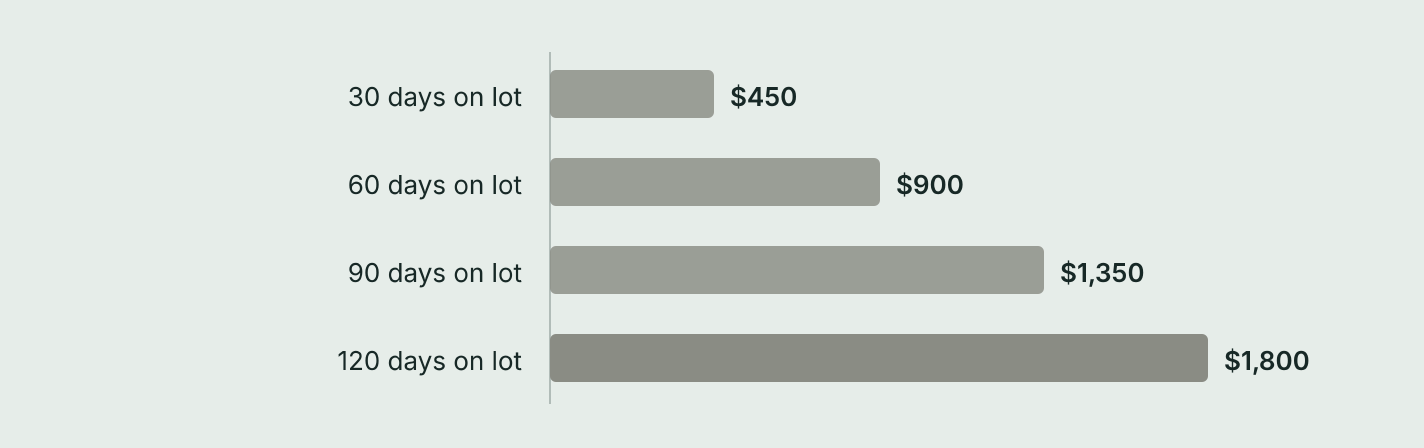
Here is a simple example. A $60,000 unit at 9% a year costs about $450 a month in interest. That works out to roughly $15 a day.
Days on the lot are the real cost driver. At 30 days the interest on that unit is $450. At 60 days it is $900, at 90 days $1,350 and at 120 days $1,800. A unit that sells in a month costs a quarter as much as one that sits for four. Track days-to-sale for each unit, not just your annual turn.
If a lender quotes a factor rate instead of an interest rate, convert it before you compare. A factor rate is a flat multiplier on the amount you received, so it does not shrink as you repay. For example, a 1.28 factor repaid over 8 months works out to roughly 65–85% APR, depending on how quickly the money comes back. Ask every lender for the total dollar cost and the APR in writing.
Floor Plan Financing vs. Other Options #
Each option fits a different job. Compare the categories, then check the specific offer.
| Option | Typical cost | Speed | What it needs |
|---|---|---|---|
| Floor plan line of credit | Interest on each unit from funding until sale; rate set by the lender | Quick once the line is open | Identifiable units (serial or VIN), sales history, financial statements |
| Bank term loan | Fixed or variable interest, shown as an APR in the offer | Slow, often weeks to months | Strong credit, tax returns, collateral, an existing banking relationship |
| SBA 7(a) loan | Rates capped under SBA rules, plus any guaranty fee | Slow; paced by the lender's process | SBA eligibility, lender underwriting, full paperwork |
| Line of credit | Interest on the drawn balance; rate set by the lender | Moderate | Revenue history, usually a personal guarantee |
| Merchant cash advance | Factor rate; 1.28 for example ≈ 65–85% APR | Fast, often within days | Card or bank deposit history; repayment taken from daily sales |
| Business bridge loan | Interest or fee set by the lender; compare the APR | Fast to moderate | A clear payoff source, such as a pending sale or a refinance |
A bank term loan is often the cheapest money for a well-documented business, but it funds a fixed amount over a fixed term. It does not refill itself as your stock sells. If your timing is slow and your bank file is strong, a bank can be the right call.
An SBA 7(a) loan can be used for working capital, and working capital can include inventory. The program is backed by an SBA guarantee and is applied for through a participating lender. The process is thorough, which means it is slower. The SBA's free Lender Match tool can help you find participating lenders.
A line of credit can work for general cash needs, but it is not built around individual units. A floor plan line ties each draw to a specific asset, which is why many inventory-heavy owners prefer it.
A merchant cash advance pays fast, but its repayment comes out of your daily sales, so the cost and the timing both move with your revenue. The Federal Reserve's Small Business Credit Survey tracks which lender types small firms apply to and how those applications turn out. Read that data before you assume any single option is typical.
A business bridge loan covers a short gap until a known payoff arrives. It is only a good fit when that payoff is real and dated.
Who Qualifies and What Lenders Look At #
Floor plan lenders look at the asset first. They want to know the age, make, condition and resale value of each unit, and they want proof you own it free of other liens. Next, they look at how fast you sell. A lender who sees units turning in 45 days is more comfortable than one who sees units aging past 120.
They also review your financial statements, time in business and the owners' personal credit. Many will ask for a personal guarantee. For vehicle dealers, licensing and a clean title history are usually required.
Expect the lender to ask for recent sales reports, a current inventory list with serial numbers, and bank statements. Having these ready shortens the approval and keeps the audit simple.
When Floor Plan Financing Is the Wrong Tool #
Floor plan financing is a poor fit in several situations:
- Your stock turns over quickly. If units sell within a few weeks, interest is small and a cheaper, more flexible line may serve you better.
- Your margins are thin. If the gross profit on a unit is smaller than a few months of interest, every slow sale wipes out the deal.
- Your units lose value fast. Seasonal goods or fast-depreciating equipment can fall below the loan balance before they sell.
- You can pay cash. Paying cash for a unit avoids interest entirely.
- You need money for something other than stock. A new building or major equipment is usually better served by a longer loan. The SBA's 504 program is built for major fixed assets such as real estate and equipment, and its microloans of up to $50,000 are offered through nonprofit intermediaries for smaller needs.
Can I get floor plan financing with bad credit? #
Sometimes. Floor plan lenders weigh the inventory, your sales record and how quickly units move, so weak personal credit is not an automatic stop. Expect a smaller limit, a higher rate or a required personal guarantee. Be wary of anyone who promises approval without seeing your units and sales history. Before you sign, get the total dollar cost and the APR in writing.
How does vehicle floor plan financing work? #
The lender pays the manufacturer or auction for a specific vehicle and holds a lien on it. The vehicle sits on your lot while interest accrues. When it sells, you pay off that vehicle's balance, the lien is released, and the credit becomes available for the next unit. Lenders often audit inventory and may require a partial payment on units that stay unsold past an agreed point. Keep titles and stock records clean, because the lender will check them.
What is floor plan financing interest expense? #
It is the interest you pay on each financed unit from funding until payoff, recorded as an expense on your books. For example, a $60,000 unit at 9% a year accrues about $450 a month. Interest expense rises with every day a unit sits unsold, so it is a direct cost of slow sales. Track it per unit, not only in total, so you can spot aging stock early.
Is an SBA dealer floor plan program better than a private line? #
It depends on what you need. SBA-backed loans can fund working capital, including inventory, but they arrive as term loans rather than revolving lines that clear each unit as it sells. A private floor plan line usually moves faster and matches inventory cycles more closely, though its rate can be higher. If your sales are slow and your fixed costs are the bigger problem, an SBA loan may cost less overall. Ask a participating lender which structure fits your stock.
Your lot, your turn rate, your decision #
A floor plan line fits when units sell within a predictable window, the margin on each unit covers its interest with room to spare, every unit can be identified by serial or VIN, and your records are clean enough for an audit. It does not fit when units sit for months, margins are thin, or the money is needed for something other than stock.
If your numbers fit, start your request and we will walk through the cost on your own units.
Sources #
The guide you are reading is general background; it does not give advice for your situation. Figures here are illustrative; the only terms that apply to you are those set out in an agreement you sign. Read how we work and how our fee works.